Day Trips from Blantyre: A Historical Route Through Tea Country

/ By The Thyolo House

Day Trips from Blantyre: A Historical Route Through Tea Country

day trips from blantyremalawi historythyolo travel

The best day trips from Blantyre are not the ones that take you furthest. They are the ones that follow a story. Southern Malawi is densely layered with history — Scottish missionaries who built cathedrals brick by brick, Italian planters who arrived in the 1920s and never left, slave routes that converge on the lakeshore, and tea estates that have been running, more or less continuously, since before the First World War. Most travellers race past all of it on the way to Liwonde or Lake Malawi. This guide does the opposite. It strings together a single, drivable historical route that begins at Blantyre's oldest church and ends with lunch on a hundred-year-old Italian tea estate in Thyolo, with optional detours into the deeper colonial archive of the south.

This is one of the more rewarding day trips from Blantyre precisely because it asks nothing dramatic of you — no 4×4, no early morning game drive, no border paperwork. Just a tank of fuel, a willingness to stop and read the inscriptions, and a sense that landscapes in this part of Malawi are rarely as quiet as they look.

Why Blantyre Is the Best Base for Historical Day Trips in Southern Malawi

Blantyre is, almost uniquely in Africa, a city named after a Scottish village — the birthplace of David Livingstone, in Lanarkshire. The Church of Scotland's Blantyre Mission was founded here in 1876, and the city that grew around it became Malawi's commercial capital. That heritage is not just academic. It is structural. The road network out of Blantyre still follows the cart tracks the missionaries and early traders cut through the hills. The escarpment villages still cluster around mission churches. Tea, coffee and tobacco — the three crops that defined colonial Nyasaland — are all grown within an hour of the city centre.

What this means in practice is that any one-day loop from Blantyre is also a small archaeology of the late nineteenth and early twentieth centuries. You can leave a city-centre hotel at 9am, stand inside a hand-built Victorian church by 9.30, walk the gardens of the original African Lakes Corporation depot by 11, drive the old escarpment cart track by midday, and be eating handmade pasta on an Italian tea estate by 1pm. Few cities in the region offer that kind of continuity.

Manicured estate gardens at The Thyolo House on Conforzi Tea Estate
The estate gardens at The Thyolo House — the eventual destination of this historical route.

Stop One — St Michael and All Angels: The Church the Scottish Missionaries Built by Hand (1888)

Begin in central Blantyre at St Michael and All Angels Church, completed in 1891 after roughly three years of construction. The story is unusually well-documented. The architect, the Reverend David Clement Scott, had no formal architectural training. He drew the plans himself, in the style of an Italian basilica with Moorish arches, and supervised local Yao and Mang'anja workers who fired the bricks on site from local clay. There were no engineers. There were no machines. The towers — domed, arched, slightly improbable — went up by trial and error.

The result is one of the most extraordinary mission buildings in sub-Saharan Africa, and it is still in active use as an Anglican parish. Entry is free; a donation to the parish is appreciated. Allow 30–45 minutes. The caretakers are usually happy to point out the original baptismal font and the foundation stones inscribed with the names of the first converts. If your morning is tight, this is the single stop you should not skip.

Stop Two — The Old Mandala House and the Birth of African Lakes Corporation

From St Michael's it is a short drive — perhaps 15 minutes — to Mandala House, the oldest European building still standing in Malawi (built 1882). It served as the headquarters of the African Lakes Corporation, the trading company set up by the Moir brothers, John and Frederick, to support the Livingstonia Mission and to introduce, in their own words, "Christianity and commerce" along the Shire and Lake Malawi.

The complex now houses the Society of Malawi archives and library on the ground floor (open most weekday mornings — verify hours on arrival), with a small café and the La Caverna art gallery. The archives hold original ALC ledgers, missionary letters and early photographs. For anyone interested in how the colonial economy actually functioned at ground level — the tea, the rubber, the steamboats on the Shire — this is the most concentrated source in the country. Allow an hour, longer if the archives are open.

Stop Three — Driving the Thyolo Escarpment Road: How a Colonial Cart Track Became a Tea Highway

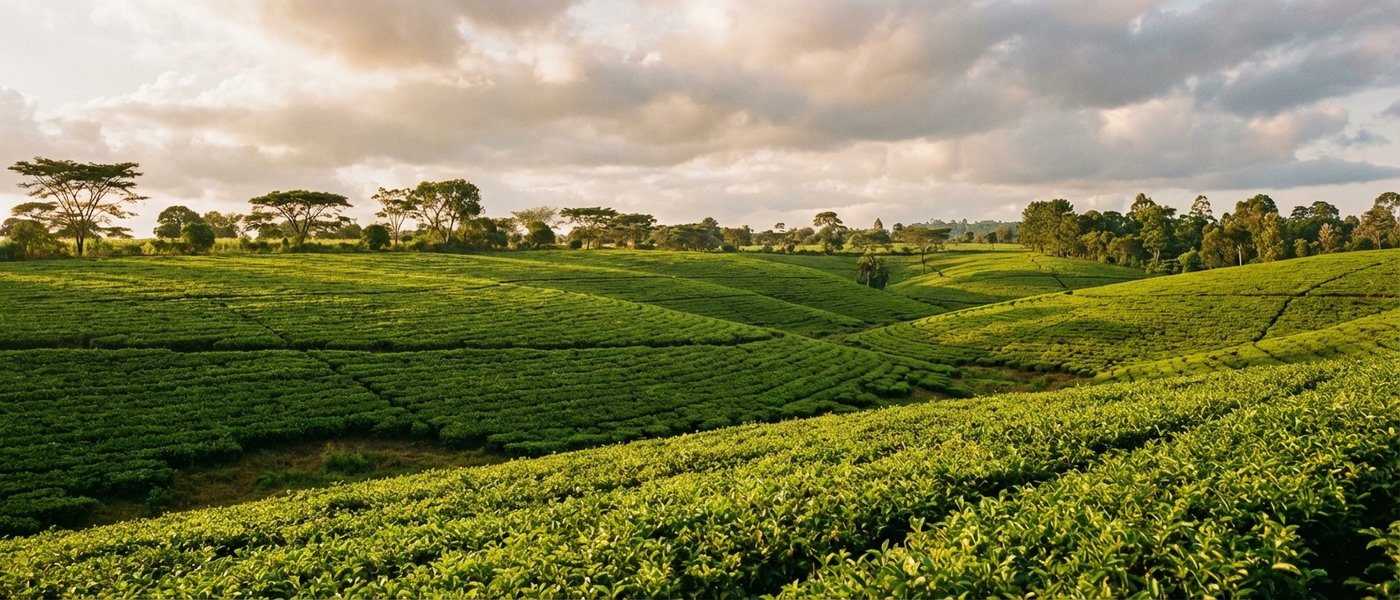
Leaving Blantyre south on the M2, the road climbs almost immediately. Within twenty minutes you are on the Thyolo Escarpment — a long, fertile ridge that the British surveyors of the 1890s identified as ideal for tea, having the right combination of altitude (around 700–1,000 metres), high rainfall, and acidic soil. The road you are driving was originally a cart track widened in stages between 1900 and the 1930s to move tea chests down to the railhead at Limbe and on to the port at Beira in Mozambique.

It is worth pulling over once or twice. The view east — across the tea, towards the distant blue wall of Mount Mulanje — is one of the great landscapes of central Africa, and it is the same view that Italian, British and Portuguese planters first saw a century ago. There is nothing dramatic to do here, no gate to enter, no fee to pay. You are simply driving through living history. The road itself is the artefact.

Indigenous forest meeting the tea-covered slopes of Thyolo's escarpment
The Thyolo escarpment — tea on one side, indigenous forest on the other, much as it has looked for a century.

Stop Four — Conforzi Tea Estate: The Italian Family Who Planted Tea in 1925 and Never Left

Roughly 40 minutes south of Limbe, you arrive at Conforzi. The story is one of the more unusual chapters in Malawi's plantation history. In 1925, an Italian agronomist named Ignaco Conforzi arrived in what was then Nyasaland and planted tea on the slopes near Thyolo. He was one of very few Italians in the south of the country at a time when British and Scottish planters dominated the industry. He stayed. His family stayed. The estate has been in continuous Conforzi family ownership for a hundred years — an almost unheard-of run in African agriculture, where colonial estates were typically sold, nationalised, broken up or abandoned within a generation or two of independence.

The estate today still produces tea (and coffee, and macadamia), and the Conforzi family — now in its fourth Malawian generation — remains directly involved. For the deeper version of the story, including the wartime internment chapter that almost ended the family's stay in Africa, our long-form piece on the history of Conforzi Tea Estate is worth reading either before you set out or while you are sitting on the veranda after lunch.

Stop Five — Lunch and a Pause at The Thyolo House: A Living Chapter of the Conforzi Story

Within the estate, on a quiet rise looking out over the tea, sits The Thyolo House — a small boutique hotel and restaurant run by Flavia Conforzi, a great-granddaughter of Ignaco. Flavia is an Italian-Malawian artist as well as a host, and the house carries that double identity throughout: Italian cooking, Malawian gardens, family furniture, and Flavia's own paintings on the walls.

The restaurant is the natural lunch stop on this route. The menu changes with what is in the garden — most ingredients are grown within walking distance of the kitchen — but the kitchen leans Italian: handmade pasta, slow-cooked ragù, cotoletta when the butcher delivers, fresh bread baked in-house. There is a pool to sit beside, a forest trail behind the house if you want to walk off lunch, and a tea-plantation loop you can do in under an hour with one of the estate guides.

Italian cotoletta plated with garden greens at The Thyolo House restaurant
Italian cooking, Malawian ingredients — the kitchen at The Thyolo House.

You do not need to be staying overnight to eat here, but it is worth calling ahead, especially at weekends or in high season. The dining rooms are small by design.

Optional Extension — Magomero and the Slave Route Memorials South of Thyolo

If you have started early and the day is running well, there is one further detour that adds genuine depth to the route: a swing east towards Magomero, in the rolling country between Thyolo and Chiradzulu. This was the site of the original Universities' Mission to Central Africa settlement, established in 1861 by Bishop Charles Mackenzie at Livingstone's invitation, and the first formal attempt by Anglican missionaries to establish a station in the interior of what is now Malawi. The mission failed within two years — Mackenzie died of fever, the settlement was abandoned, and the Anglicans regrouped on Zanzibar — but the site is significant. It is also adjacent to one of the corridors of the nineteenth-century Yao slave-trade route from the lake down to Quelimane on the Mozambique coast.

There is no formal museum at Magomero. What there is, is landscape — and a small handful of memorial stones and church remnants if you know where to look. A local guide is essential; ask at The Thyolo House and we can usually arrange one with a day's notice. Allow three additional hours including drive time.

Practical Logistics: Distances, Driving Times, and the Best Order to Run This Loop

The full loop, ending at The Thyolo House for lunch and an afternoon, runs roughly as follows:

  • Blantyre city centre → St Michael and All Angels: 5 minutes. Free entry; donation appreciated.
  • St Michael's → Mandala House: 15 minutes. Free entry; café and gallery on site.
  • Mandala House → Limbe roundabout (start of M2): 15 minutes.
  • Limbe → Conforzi Estate / The Thyolo House: 35–40 minutes via the escarpment road.
  • Optional Magomero detour: add 2.5–3 hours including drive.

The road is fully tarred the entire way. Any 2WD car will do it. There are no border crossings, no park gates, no permits. The only thing to watch is fuel — fill up in Blantyre or Limbe, not in Thyolo town, where supplies can be intermittent.

The best order is the one above: start with the church when the morning light is good, do Mandala House before the heat builds, then drive south so that you arrive on the escarpment around lunchtime when the views are clearest and the kitchen is open. If you want a broader menu of options across the region — including Mount Mulanje, Majete, and Zomba — our companion guide on places to visit near Thyolo covers the wider radius.

The Thyolo House restaurant lit up in the evening on Conforzi Estate
The restaurant at dusk — when many one-day visitors decide to make it two.

Where to Sleep If One Day Becomes Two: Staying on the Estate Itself

The most common reaction we get from people who have done this loop as one of their day trips from Blantyre is a slightly sheepish question, around four o'clock in the afternoon, about whether there are any rooms. There usually are, but only just — The Thyolo House is a five-room boutique property and weekends fill up several weeks ahead.

If you can plan it deliberately, staying overnight transforms the trip. You wake up on the estate. You walk the tea at first light, when the mist sits in the valley and the pickers are starting work. You have breakfast under the trees. You leave around mid-morning, refreshed, and the drive back to Blantyre takes 40 minutes. Our short guide on planning this exact two-day version is here: a weekend escape from Blantyre to The Thyolo House. For the rooms themselves — the heritage suite in the original house, the garden cottages, the pool cottage — see our boutique rooms.

The heritage suite at The Thyolo House with antique furniture and garden views
The heritage suite — part of the original Conforzi family residence, now one of five guest rooms.

To check availability for lunch, an estate visit, or a one or two-night stay, the simplest thing is to message us on WhatsApp on +265 884 202 040 or email thethyolohouse@gmail.com. We will tell you honestly what is open, what is in the garden that week, and whether the road conditions are favourable for the optional detours. Most one-day travellers from Blantyre find that the historical route described here gives them roughly six hours of stops and another two hours of driving — a full, satisfying day, with the bonus that it ends with lunch on a hundred-year-old Italian estate rather than in a Blantyre car park.

Of all the day trips from Blantyre we get asked about, this is the one we recommend most often to first-time visitors who want the southern Malawi story in a single, unhurried day. The history is real. The road is easy. And the pasta, by the time you arrive, is already on the stove.