/ By The Thyolo House
The Green-headed Oriole: Spotting One of Africa's Rarest Forest Birds at Thyolo House
A Flash of Green and Gold
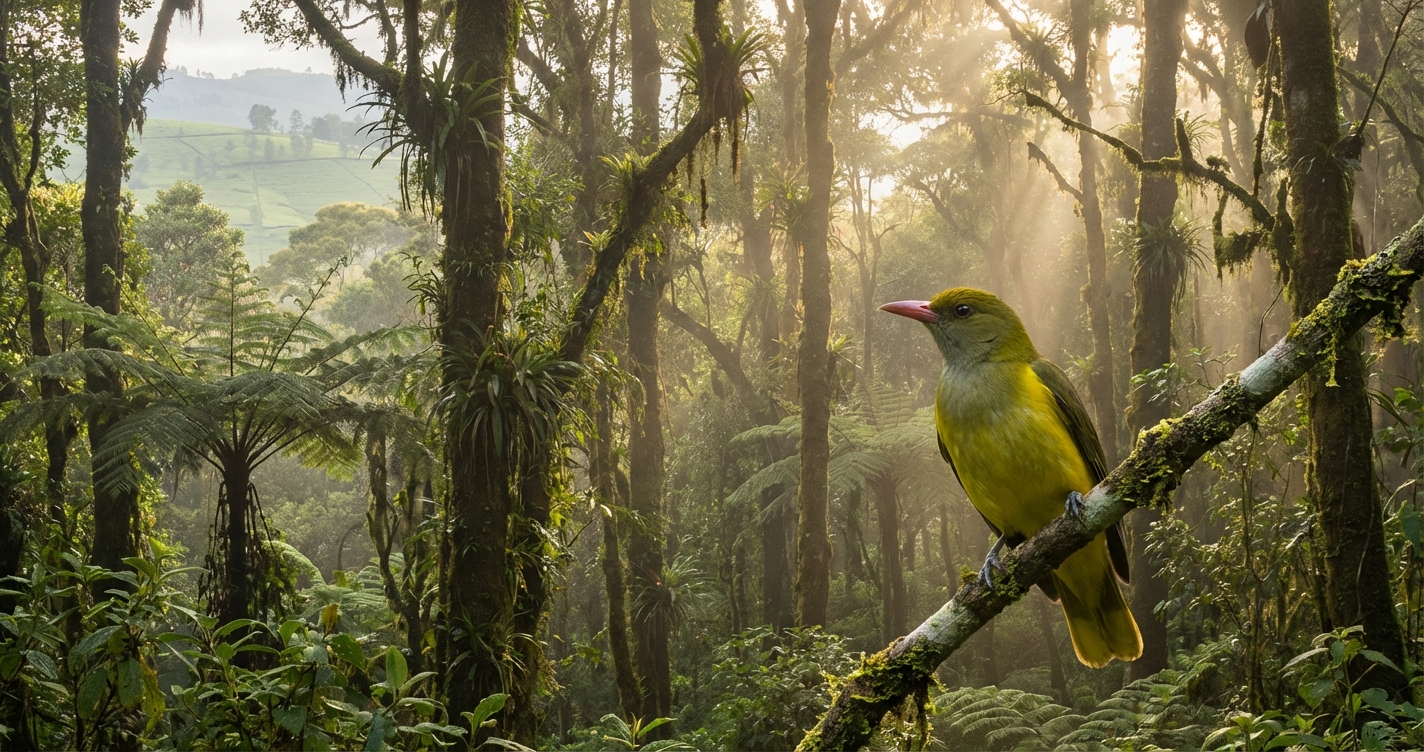
You hear it before you see it — a rich, liquid whistle floating down from the canopy of the Thyolo Forest. Then a movement in the upper branches, a glimpse of bright yellow and olive, and if you are patient and lucky, the unmistakable green head that gives this bird its name.
The Green-headed Oriole (Oriolus chlorocephalus) is one of the most beautiful and least commonly seen forest birds in southern Africa. It is resident in the indigenous forest on the Thyolo House property, on the edge of the Thyolo Forest Reserve — which means our guests have a genuine chance of seeing one without travelling far from their morning coffee.
What Makes This Bird Special
The Green-headed Oriole is not globally endangered, but it is genuinely uncommon. Its range is fragmented across a scattering of montane and lowland forests in East Africa — from the coastal forests of Kenya through the Eastern Arc Mountains of Tanzania, into northern Mozambique, and the southern highlands of Malawi. While it is reasonably common in certain Tanzanian forests, it is scarce everywhere else.
In Malawi, the bird is found in only a few locations: the remnant forest patches on Mount Mulanje, the Zomba Massif, and here on Thyolo Mountain. The Thyolo Forest Reserve, which borders our property, is one of the most accessible of these sites — and one of the smallest, at roughly seven square kilometres. That a bird this striking persists in a forest fragment this small is both remarkable and sobering.
How to Recognise It
The Green-headed Oriole is a medium-sized bird, roughly 24 centimetres long. The head and upper breast are olive-green, blending into a bright yellow body and dark olive-green wings and tail. The bill is pinkish-red, and the eye is dark. In good light, the contrast between the green head and the yellow body is vivid — you will not mistake it for anything else in this forest.
It is a canopy bird, spending most of its time in the upper storey of tall indigenous trees, where it feeds on insects, fruit, and nectar. This means you will usually be looking up, often at an awkward angle, squinting through leaves. A good pair of binoculars is essential.
Where to Find It at Thyolo House
The forest on our property connects with the Thyolo Forest Reserve, and the oriole moves freely between the two. We see — and hear — them most often in three areas:
- The forest edge behind the main house. Early morning is best. The orioles tend to forage in the canopy of the taller trees along the transition zone between the tea gardens and the indigenous forest.
- The path into the forest reserve. The trail that leads from the property into the reserve proper passes through some excellent mid-storey habitat. Listen for the call — a clear, melodious whistle, quite different from the harsher notes of the Black-headed Oriole.
- The garden trees. Occasionally, particularly during the fruiting season of certain indigenous trees, the oriole ventures into the more open garden areas around the lodge. These are the easiest sightings — the bird is lower and more exposed than usual.
Best Time to Spot the Green-headed Oriole
The bird is resident year-round, but your best chances depend on conditions:
- May to October (dry season): Reduced leaf cover makes canopy birds easier to spot. Mornings from 06:00 to 08:00 are the most productive, when the orioles are actively foraging and calling. The cooler, clearer conditions also mean better light for photography.
- November to April (wet season): The forest is lush and dense, making visual contact harder, but the birds are vocal and active. Fruiting trees attract them to specific spots, and a knowledgeable guide will know which trees are in fruit.
- Early morning, any month: The first two hours after dawn are consistently the best. The forest is quieter, the light filters in at low angles, and the birds have not yet retreated to the deep canopy.
Other Birds to Look For
The Green-headed Oriole is the headline act, but the Thyolo Forest is home to a remarkable community of forest birds, many of them scarce or range-restricted. While you are watching for the oriole, keep an eye and ear out for:
- Thyolo Alethe (Chamaetylas choloensis) — Critically endangered and found almost nowhere else. A shy, ground-dwelling bird that skulks in the forest understorey. Hearing its song is more likely than seeing it.
- White-winged Apalis (Apalis chariessa) — A small, active warbler of the forest mid-storey. Endangered and restricted to a few East African montane forests.
- Olive-headed Weaver — Uncommon and localised. Another species that uses the forest canopy and edge habitat.
- Malawi Batis — A flycatcher-like bird of the forest mid-storey, sometimes considered a distinct species from the broader Cape Batis complex.
- Sunbirds and Barbets — The forest supports several species of each, and they are often the most visible birds on any given morning.
Between the montane forest specialists and the more widespread woodland species in the surrounding tea estates, a patient birder can record 50 or more species in a day around Thyolo House without needing to drive anywhere.
A Birder's Base in Southern Malawi
Thyolo House sits at the intersection of two of southern Malawi's most important birding habitats: the Thyolo Forest Reserve and the agricultural mosaic of the tea estates. We are also about 45 minutes by road from Mount Mulanje, which harbours the only other significant populations of the Thyolo Alethe and Green-headed Oriole in the country, along with Malawi's sole true endemic — the Yellow-throated Apalis.
This makes Thyolo House a natural base for birders covering the southern Malawi circuit. Spend a morning in the Thyolo Forest, an afternoon in the tea gardens, and drive to Mulanje the next day for the highland species. You can cover remarkable ground without ever staying more than an hour from your room.
For those planning a birding trip, we recommend combining Thyolo with at least two days on Mount Mulanje. Our birdwatching guide to Mount Mulanje covers routes, target species, and seasonal timing in detail. And our complete guide to the Thyolo region covers everything else — tea estates, forest trails, accommodation, and getting around.
Conservation — Why These Forests Matter
The Thyolo Forest Reserve is one of the last remaining patches of mid-altitude rainforest in Malawi. It is under pressure from all sides — agricultural encroachment, firewood collection, and the slow fragmentation that isolates populations of forest-dependent species like the Green-headed Oriole and the Thyolo Alethe.
The fact that these birds still exist here is a testament to the conservation efforts of the Malawi government, local communities, and organisations like the Mount Mulanje Conservation Trust, which works to protect the broader montane ecosystem in southern Malawi. But the forest is small, and the pressures are real. Every patch of indigenous habitat that survives — including the forest on our property — plays a role in maintaining connectivity for these populations.
When you visit Thyolo House and walk into the forest to look for the Green-headed Oriole, you are not just birdwatching. You are bearing witness to something fragile and irreplaceable — a fragment of a world that is shrinking year by year across southern Africa. That is worth the early morning.
Ready to see the Green-headed Oriole for yourself? Check our rooms and availability, or get in touch via WhatsApp to plan your birding stay at Thyolo House.