/ By The Thyolo House
Mount Mulanje — UNESCO World Heritage, Epic Hiking & Where to Stay
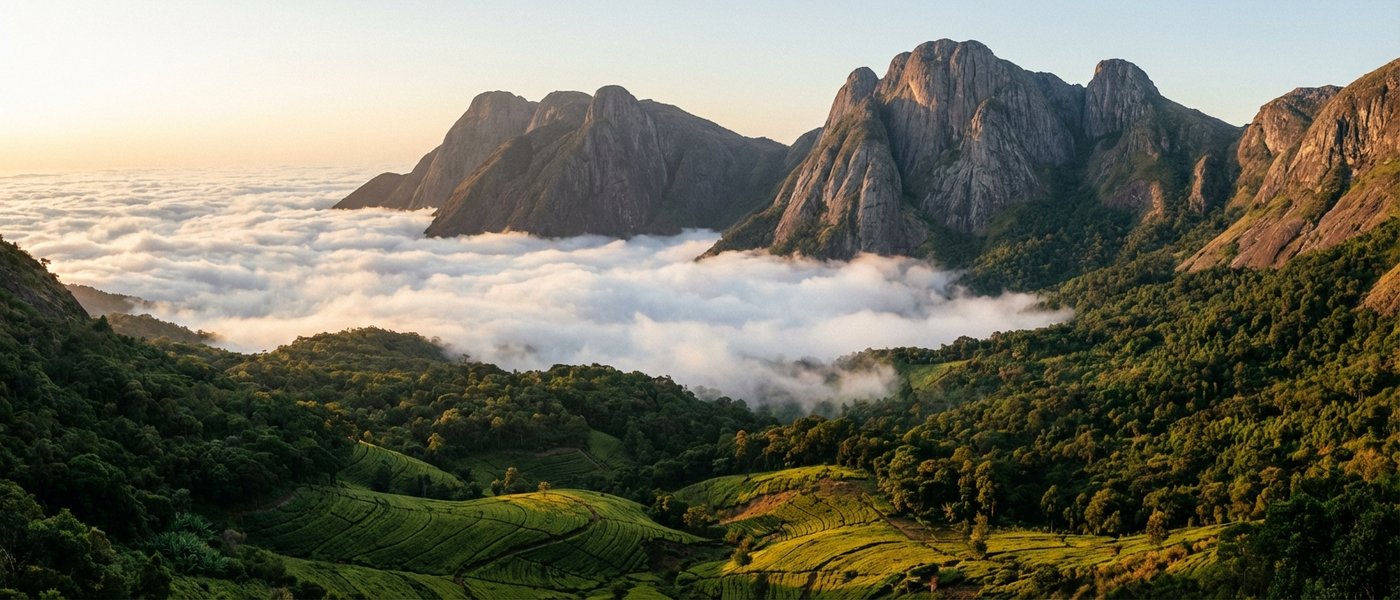
There is a moment, driving southeast from Blantyre through the tea-covered highlands, when Mount Mulanje appears. Not gradually — it arrives. One minute you are winding through green estates and small trading centres, and the next there is this enormous granite massif rising from the plains like something from another geological era. It stops conversation. It always does.
If you are searching for Mount Mulanje accommodation or planning a Mount Mulanje hiking trip, you have chosen well. This is one of the most dramatic mountains in southern Africa, home to endangered species found nowhere else on earth, and as of 2025, a UNESCO World Heritage Site — Malawi's third, and arguably its most spectacular. Whether you are here for a day hike to the waterfalls or a multi-day traverse of the plateau, this guide covers everything you need: trails, huts, guides, what to pack, and — crucially — where to stay near Mount Mulanje so you can recover properly after the mountain has had its way with you.
Mount Mulanje: What Makes It Extraordinary
Mount Mulanje is one of the largest inselbergs on the planet — a massive island of rock that rises abruptly from the surrounding plains to a peak of 3,002 metres at Sapitwa, making it the highest point in south-central Africa. The massif covers roughly 650 square kilometres of peaks, plateaus, river valleys, and sheer cliff faces. It has its own weather systems. Clouds form at its base while the summit bakes in sun, or vice versa. The mountain makes its own rules.
The geology is ancient — Precambrian syenite and granite, shaped over hundreds of millions of years into the domes, spires, and buttresses that give Mulanje its unmistakable profile. From a distance, it looks like a fortress. Up close, it feels like one too.
UNESCO World Heritage Status (2025)
In 2025, Mount Mulanje was inscribed on the UNESCO World Heritage List, becoming Malawi's third World Heritage Site alongside Lake Malawi National Park and the Chongoni Rock Art Area. The designation recognises Mulanje's outstanding universal value — its unique ecology, its geological significance, and its cultural importance to the people of Malawi, for whom the mountain has been a sacred place for centuries.
The UNESCO recognition is significant for several reasons. It brings international attention and, with it, conservation funding and infrastructure improvements. It also puts Mount Mulanje hiking Malawi on the radar of serious trekkers worldwide who follow the World Heritage trail. Visitor numbers are expected to grow, but for now, Mulanje remains refreshingly uncrowded compared to the Kilimanjaro and Drakensberg circuits. You can still have a trail — and sometimes an entire plateau — to yourself.
The Mulanje Cedar
Mulanje is home to the Widdringtonia whytei — the Mulanje cedar, Malawi's national tree and one of the most endangered conifers on earth. These magnificent trees once covered vast areas of the plateau, their aromatic, rot-resistant timber prized for centuries. Illegal logging and wildfire decimated the population, and today the cedar survives in scattered groves, many of them in remote corners of the massif accessible only on foot.
Conservation efforts are underway, led by the Mulanje Mountain Conservation Trust, and if you hike the plateau you will see young cedars planted alongside the ancient survivors. It is a hopeful sight — and a reminder of what is at stake on this mountain.
The Hiking: Routes, Huts & What to Expect
Mount Mulanje offers hiking for every level, from gentle forest walks at the base to serious multi-day traverses across the plateau. Here is an overview of the main options.
Day Hikes from Likhubula
The Likhubula Forest Station is the main access point for the mountain, located on the western side near Mulanje town. From here, you have several half-day and full-day options:
- Likhubula Falls: A relatively easy walk (about 45 minutes each way) through indigenous forest to a beautiful waterfall that cascades into a natural pool. This is the most accessible hike on the mountain and a good option if you have limited time or are travelling with children. The path follows the river through dense vegetation — keep an eye out for vervet monkeys and, if the light is right, the iridescent flash of a Livingstone's turaco overhead.
- Likhubula to the Chambe Plateau: A more demanding hike that climbs steeply from the forest station to the base of the Chambe face — one of the highest cliff faces in Africa at around 1,600 metres. The ascent takes three to four hours, and the views from the top are staggering. This can be done as a long day hike if you start early, or you can overnight at Chambe Hut.
- Skyline Path: A well-known route that follows the rim of the mountain with views in every direction. It connects several of the plateau huts and is typically done as part of a multi-day traverse, but sections can be walked as day trips if you are already on the plateau.
Multi-Day Traverses
This is where Mulanje truly reveals itself. The plateau is vast, wild, and studded with peaks, tarns, river crossings, and cedar groves. A typical traverse takes two to four days and connects a series of mountain huts maintained by the Mountain Club of Malawi and the Forestry Department.
The most popular multi-day routes:
- Likhubula → Chambe Hut → Thuchila Hut → Sombani Hut → Fort Lister: A classic three to four-day traverse from west to east, crossing the heart of the plateau. You pass through cedar forest, scramble over granite domes, and descend through the dramatic Fort Lister Gap.
- Chambe → Sapitwa summit → Thuchila: Includes the ascent of Sapitwa (3,002m), the highest peak. The final scramble to the summit involves some exposed rock and is not technically difficult but requires a head for heights and a guide who knows the route. Sunrise from Sapitwa is one of Africa's great mountain moments.
- Lichenya Plateau route: Ascends from the south side to the Lichenya Plateau, known for its wildflowers and sweeping grasslands. Less trafficked than the Chambe-Thuchila circuit, and all the better for it.
The Mountain Huts
Mulanje's hut system is basic but functional. The main huts — Chambe, Thuchila, Chisepo, Sombani, and Lichenya — provide shelter, sleeping platforms, fireplaces, and sometimes water from nearby streams. You need to bring your own sleeping bag, food, and cooking equipment. There are no shops or restaurants on the mountain.
The huts are maintained by volunteer effort and modest fees paid at the Likhubula Forest Station. Conditions vary — some huts are in better shape than others — but they are clean, dry, and positioned in spectacular locations. Falling asleep in Thuchila Hut with the stars visible through the doorway and the sound of the river below is an experience that stays with you.
Hiring a Guide
Guides are available at the Likhubula Forest Station and are strongly recommended, particularly for multi-day hikes and the Sapitwa ascent. The trails are not always well-marked, the weather can change rapidly, and the guides — most of whom have grown up on the mountain — know every path, every water source, and every shortcut.
Porters can also be hired to carry supplies, which makes the multi-day traverses significantly more enjoyable. Fees are modest and should be agreed in advance. Tipping is customary and appreciated — these are physically demanding jobs in challenging conditions.
For a step-by-step walkthrough of the MMCT booking process, fees, and what to expect, see our Mulanje Trust climb guide.
New for 2026: Trek Mulanje's Mulanje-Zomba Highlands Adventure
The hiking landscape around Mulanje is evolving. Trek Mulanje is launching a new multi-day adventure in 2026 that connects Mount Mulanje with the Zomba Plateau — the Mulanje-Zomba Highlands Adventure. This guided trek links two of southern Malawi's most dramatic highland areas in a single itinerary, offering hikers the chance to experience both the raw granite grandeur of Mulanje and the gentler, forested beauty of Zomba in one trip.
Details are still emerging, but this kind of product development is exactly what Mount Mulanje UNESCO recognition has helped catalyse — structured, well-guided experiences that make the mountain accessible to international trekkers who might otherwise default to East Africa. If you are planning a trip for later in 2026, it is worth looking into.
Where to Stay Near Mount Mulanje
Here is the honest truth about Mount Mulanje accommodation: the options closest to the mountain are limited, and most of them cater to backpackers and budget travellers. If you have just spent two or three days on a granite plateau sleeping in mountain huts, eating trail food, and hauling yourself up rock faces, what you want when you come down is not another basic lodge. You want a proper bed, a hot shower, a swimming pool, and a meal that someone has put genuine craft into. That is where The Thyolo House comes in.
The Thyolo House — Your Boutique Base for Mount Mulanje
The Thyolo House sits on the historic Conforzi Tea Estate in the Thyolo highlands, approximately 30 minutes by car from Mount Mulanje. It is a boutique hotel with five individually designed rooms in a century-old colonial farmhouse, surrounded by tea gardens, indigenous forest, and the kind of deep, green quietness that your body craves after days on the mountain.
This is not a compromise — "well, there's nothing closer, so I suppose this will do." This is a genuine destination. Our rooms range from the Heritage Suite in the main house to the Forest Cottage tucked against the edge of the indigenous woodland. There is a swimming pool shaded by ancient trees — and after a Mulanje traverse, you will want to live in that pool. There are forest trails and tea plantation walks that let you stretch your legs without punishing them. And there is Flavia Conforzi's art studio, where you can channel whatever the mountain stirred up in you into something tangible.
But the thing that elevates The Thyolo House from "nice place to stay" to "the obvious choice" is the restaurant. Italian-Malawian fusion, cooked with ingredients from the estate garden, served on the veranda or under the stars. After three days of instant noodles and trail mix on the plateau, sitting down to handmade pasta, fresh salads, and a glass of wine while looking out over the tea gardens feels like something close to heaven. Breakfast is included with your room, and upgrading to half-board or full-board is the smartest decision you will make.
Other Accommodation Near Mount Mulanje
In the interest of giving you the full picture:
- Kara O'Mula: Located at the base of the mountain near Likhubula, Kara O'Mula is the closest lodge to the main trailhead. It offers basic rooms and camping in a beautiful forest setting. It is functional and well-positioned for early morning starts, but facilities are simple — do not expect luxury.
- AfricaWildTruck Campsite: A camping and overlander site near the mountain. Good for budget travellers and groups, with basic facilities. Bring your own tent and supplies.
- Hapuwani: Budget guesthouse accommodation in or near Mulanje town. Practical for a night before or after, but not somewhere you would choose to linger.
None of these options are boutique. If you want a comfortable, characterful base where you can recover in genuine style — a real bed, a real meal, a real experience — The Thyolo House is the only option in the region that delivers that. And at 30 minutes from the mountain, the drive is short enough to make it practical for both pre-hike preparation and post-hike recovery.
The Perfect Mount Mulanje Itinerary
Here is how we would plan a Mount Mulanje trip, if someone asked us — and people do ask, regularly.
Day 1: Arrive at The Thyolo House
Fly into Chileka Airport (Blantyre) or drive from Lilongwe. Transfer to The Thyolo House — about 40 minutes from Blantyre, 20 minutes from Limbe. Check in, swim, decompress. Walk the tea gardens or the forest trail. Have dinner on the veranda. Sleep deeply in clean sheets. You are going to appreciate this memory when you are in a sleeping bag on the plateau.
Day 2: Drive to Mulanje, Begin the Hike
After a proper breakfast — estate coffee, fresh fruit, eggs — drive to the Likhubula Forest Station (roughly 30 minutes). Register, hire your guide and porters, and begin the ascent. If you are doing a day hike, you can return to The Thyolo House for dinner. If you are heading up to the huts, this is where you say goodbye to comfort for a few days.
Days 3-4: On the Mountain
Trek the plateau. Summit Sapitwa if conditions allow. Sleep in the huts. Watch the sunset from a granite dome three thousand metres above sea level. Let the mountain do what mountains do — strip things back to what matters.
Day 5: Descend and Recover
Come down the mountain. Your knees will have opinions. Drive back to The Thyolo House. Shower. Pool. Cold drink. Dinner that makes you emotional because you have been eating packet soup for three days. This is the day you will remember most fondly, because contrast is everything.
Day 6: Explore Thyolo or Depart
If you have time, spend a morning exploring the Thyolo Forest Reserve (excellent birding — the critically endangered Thyolo Alethe lives here), or visit the nearby Satemwa Tea Estate for a tasting. Then head back to Blantyre or onward to your next destination.
This is a rough framework — adjust it to suit your pace and interests. The point is this: the mountain and the recovery are both part of the experience. Do not shortchange either one.
Practical Information for Mount Mulanje Hikers
Getting There
- From Blantyre: Mount Mulanje is approximately 70 kilometres southeast of Blantyre. The drive takes about 1 hour 15 minutes on a tarmac road through the Thyolo highlands.
- From The Thyolo House: About 30 minutes by car to the Likhubula Forest Station. We can help arrange transport or give directions.
- From Lilongwe: Approximately 350 kilometres. Most visitors fly into Chileka Airport near Blantyre.
Best Time to Visit
The dry season — May to October — offers the best hiking conditions: clear skies, cooler temperatures, minimal rain, and the best visibility from the peaks. June and July are the coldest months on the plateau (it can drop near freezing at night), but the days are crisp and bright.
The wet season (November to April) brings afternoon thunderstorms, mist, and slippery trails, but also the most dramatic scenery — waterfalls at full power, wildflowers on the plateau, and the mountain at its most atmospheric. Experienced hikers can manage the wet season, but river crossings become more challenging and some routes may be impassable after heavy rain.
March to May is a transitional period that can offer good hiking with fewer visitors and a lush, green landscape.
What to Pack
For day hikes:
- Sturdy hiking boots with ankle support (the trails are rocky and uneven)
- At least two litres of water per person
- Sun protection — hat, sunscreen, sunglasses (the plateau is exposed)
- Rain jacket (weather changes rapidly, even in the dry season)
- Warm layer — a fleece or light down jacket for the summit and for when clouds roll in
- Snacks and a packed lunch
- Camera — the views are spectacular
For multi-day hikes, add:
- Sleeping bag rated to at least 0°C (it gets cold on the plateau at night)
- Sleeping mat
- Headlamp with spare batteries
- Cooking equipment and food for the duration — there is no resupply on the mountain
- Water purification tablets or a filter (stream water should be treated)
- First aid kit including blister treatment (you will need it)
- Dry bags or waterproof stuff sacks for your gear
The Thyolo House can store any luggage you do not need on the mountain. No point hauling your suitcase up to Chambe Hut.
Fees and Permits
Entry fees are paid at the Likhubula Forest Station. Fees for foreign visitors differ from resident rates — check current prices on arrival, as they are updated periodically. Guide and porter fees are negotiated at the forest station. Hut fees are also paid there. Carry cash in Malawian kwacha — there are no card facilities on the mountain or at the forest station.
Safety
Mount Mulanje is a serious mountain. People have died here — from exposure, falls, and getting lost in mist. Take it seriously:
- Always hike with a guide on unfamiliar routes, especially in poor visibility
- Start early to avoid afternoon mist and storms
- Tell someone your plans — leave your itinerary at the forest station and with your accommodation
- Carry enough water and warm clothing — conditions change fast
- Do not attempt Sapitwa in bad weather — the summit scramble involves exposed rock and there is no shelter
Likhubula Falls — The Must-Do Stop
Even if you are not planning a full hike, Likhubula Falls is worth the visit. The trail from the forest station winds through dense montane forest — tall trees draped in mosses and epiphytes, the sound of the river growing louder as you approach. The falls themselves are not the highest in Malawi, but they are beautiful — a curtain of water dropping into a clear pool surrounded by rocks and forest.
It is an easy walk, suitable for most fitness levels, and takes about 45 minutes each way. You can swim in the pool at the base of the falls (the water is cold and very refreshing after the walk). Pack a towel and a picnic, and give yourself a couple of hours to enjoy the spot.
If you are staying at The Thyolo House and want a gentler day out, the Likhubula Falls walk combined with a stop in Mulanje town for the market makes a lovely half-day excursion. Drive to the falls in the morning, hike, swim, then browse the Mulanje market on the way back for macadamia nuts, local fruit, and chitenge fabric. Return to The Thyolo House for a late lunch and an afternoon by the pool. Perfect.
For more ideas, see our guide to the best Mulanje day trips and where to eat near Mulanje.
Why the Mountain Needs a Place Like This
Here is something that anyone who has hiked in East or southern Africa will recognise: the accommodation gap. The mountains are extraordinary. The places to stay near them are often not. You come down from an epic, life-affirming experience on the trail, and your options are a concrete guesthouse with a foam mattress and a cold-water shower, or a campsite where you are still essentially roughing it.
Mount Mulanje has had this problem for a long time. The mountain itself is world-class — the UNESCO committee confirmed what hikers have known for decades. But the infrastructure around it has not kept pace. The lodges near the base serve a purpose, but they are not where you want to spend three nights.
The Thyolo House fills that gap. It is close enough to be practical (30 minutes), far enough to feel like a different world (tea gardens, forest, absolute quiet), and good enough to be the part of the trip you look forward to as much as the summit. A boutique hotel with five rooms, an Italian fusion restaurant, a pool, forest walks, and an artist host who will make you feel like a guest in her home rather than a customer in her business.
We are biased, obviously. But we also know that when you come down from that mountain, sore and elated and trail-dusty, what you want is not another night of roughing it. You want someone to hand you a cold drink, point you toward the pool, and tell you that dinner will be pasta made from scratch, served on the veranda, at whatever time you feel ready.
That is what we do.
The Mountain and the Tea Garden
Mount Mulanje and the Thyolo highlands are separated by about 30 minutes of road, but they share a deeper connection. Both are products of the same geological forces that created the Shire Highlands — the ancient rift that lifted this corner of Malawi into a cooler, greener, more ecologically complex landscape than the plains below. The tea that grows on the Conforzi estate exists because of the altitude and rainfall that the mountain helps generate. The forest that borders our garden is part of the same ecological corridor that runs up to Mulanje's slopes.
When you stand on the veranda of The Thyolo House on a clear morning, you can see Mount Mulanje on the eastern horizon — that unmistakable flat-topped silhouette. It is a reminder that the mountain is always there, waiting for the next adventure. And when you come back from that adventure, the tea garden is waiting too.
If you are planning a trip to Mount Mulanje — whether it is a day hike to Likhubula Falls or a full Sapitwa summit attempt — we would love to be part of your journey. Get in touch to talk through your plans, or message us on WhatsApp to check availability and book your stay. We can help with transport arrangements, guide recommendations, and building an itinerary that makes the most of your time in southern Malawi's highlands.
If you are still exploring what this corner of Malawi has to offer, you might also enjoy our guides to every Mulanje hiking trail, accommodation near Mulanje, day trips from Blantyre, and things to do in Thyolo — both of which feature Mount Mulanje alongside the many other reasons this region deserves more than a passing visit.
The mountain will test you. The tea garden will restore you. That is the rhythm of a Mulanje trip done right.