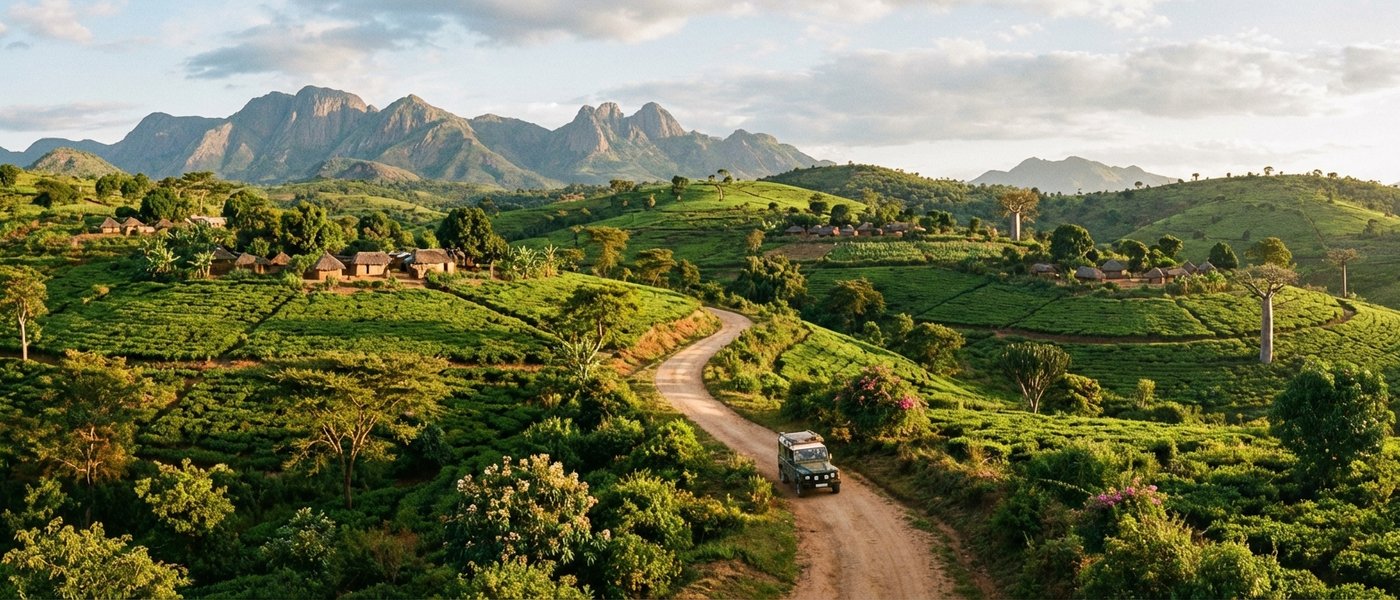
/ By The Thyolo House
Southern Malawi Travel: A 10-Day Route Through the Highlands
Most visitors to Malawi head straight for the lake — and it's easy to see why. But southern Malawi travel offers something the lakeshore doesn't: altitude, tea-scented air, granite peaks, ancient forests, and some of the best wildlife viewing in East Africa. This 10-day route through the southern highlands links five distinct destinations into a single, unhurried journey — from the commercial energy of Blantyre to the river safaris of Liwonde, with tea country, mountain trails, and a colonial-era plateau town in between.
\n\nIt's the kind of trip that rewards slow travel. Distances are short (you'll rarely drive more than two hours between stops), the roads are mostly tarmac, and each place has its own character. Whether you're a hiker chasing Sapitwa Peak, a birder scanning the Shire River, or someone who simply wants to sit on a veranda with a cup of single-origin Thyolo tea, this route delivers.
\n\nHere's how to spend 10 days in the southern highlands — with distances, practical tips, and honest recommendations for where to stay along the way.
\n\nWhy Southern Malawi Deserves Its Own Trip
\n\nSouthern Malawi is where the country's geography gets dramatic. The Shire Highlands rise above 1,000 metres, creating a cooler, greener landscape than the lakeshore or the Lower Shire Valley. Mount Mulanje — recently added to the UNESCO World Heritage List — dominates the skyline at 3,002 metres, the highest summit in south-central Africa. The Zomba Plateau, once the seat of colonial government, sits at 1,800 metres with views that stretch to Mozambique.
\n\nBetween the mountains, Thyolo district is blanketed in tea estates that date back over a century. And to the north, Liwonde National Park — managed by African Parks — has become one of the continent's most impressive conservation success stories, with elephant, hippo, and reintroduced predators along the Shire River.
\n\nThe south also has better infrastructure than most visitors expect. Blantyre is Malawi's commercial capital, with decent hotels, restaurants, and an international airport. Roads connecting the main stops are paved and well-maintained. And because fewer tourists come this way, you'll often have trails, lodges, and river boats largely to yourself.
\n\nIf you're planning a broader Malawi itinerary, consider giving the south its own week — or better yet, the full ten days outlined here.
\n\nDays 1–2: Blantyre — Markets, Museums & a Gateway City
\n\nBlantyre is the logical starting point. Chileka International Airport receives flights from Johannesburg, Nairobi, Addis Ababa, and Dar es Salaam, and the city has enough to fill a day or two before you head into the highlands.
\n\nWhat to do
\n\n- \n
- Mandala House — Malawi's oldest building (1882), now home to a café, bookshop, and small gallery. Good coffee, shaded courtyard, and a useful first stop for maps and guidebooks. \n
- Chichiri Museum — The national museum covers Malawi's history from the Stone Age through the Maravi Empire to independence. Small but well-curated. \n
- Limbe Market — Sprawling, chaotic, and authentic. This is where Blantyre does its daily shopping. Go in the morning for the best produce and fabric sections. \n
- St Michael and All Angels Church — Built by David Livingstone's mission in 1891, it's a striking piece of Scottish-African architecture. \n
For a fuller list of excursions, see our guide to day trips from Blantyre.
\n\nWhere to stay
\n\nBlantyre has a range of hotels from budget to upmarket. Protea Hotel by Marriott and the Amaryllis Hotel are reliable mid-range options. If you'd rather skip the city and go straight to the highlands, The Thyolo House is only 40 minutes from Blantyre — close enough to use as a base for a day trip into town.
\n\nPractical details
\n\n- \n
- Airport transfer: Taxis from Chileka to central Blantyre cost MWK 15,000–25,000 (USD $8–15). Arrange through your hotel. \n
- Money: ATMs are widely available in Blantyre. Carry cash for markets and smaller towns further south. \n
- SIM card: Airtel and TNM are the main networks. Buy a SIM at the airport or any shop in town for around MWK 500. \n

Days 3–5: Thyolo — Tea Country, Forest Walks & the Conforzi Estate
\n\nFrom Blantyre, drive south through Limbe and into the Shire Highlands. Within 40 minutes the landscape changes: eucalyptus gives way to manicured tea bushes, the air cools, and the road winds through one of Africa's oldest tea-growing regions.
\n\nThyolo (pronounced \"cho-lo\") is Malawi's tea heartland. The district produces most of the country's tea and coffee, and the estates — some dating to the 1890s — are beautiful working landscapes of clipped green rows, shade trees, and colonial-era bungalows. It's also home to pockets of indigenous rainforest that harbour rare birds and endemic plants.
\n\nWhat to do
\n\n- \n
- Satemwa Tea Estate — Factory tours, tea tastings, and seasonal coffee walks. The estate has been in the Kay family since the colonial era, and the tours are informative without being touristy. Huntingdon House, the original 1928 family home, offers boutique accommodation and afternoon tea. \n
- Thyolo Forest Reserve — One of Malawi's last patches of mid-altitude rainforest. Walking trails through the canopy are excellent for birding — look for the Thyolo alethe, a globally endangered species found almost nowhere else. \n
- Tea plantation walks — Several estates offer guided walks through the fields. Early morning is best, when pickers are at work and mist hangs in the valleys. \n
- Art workshops — At The Thyolo House, owner Flavia Conforzi — an Italian-Malawian artist — occasionally runs painting and craft sessions using local materials. \n
For a deeper dive into the district, read our complete guide to Thyolo.
\n\nWhere to stay
\n\nThe Thyolo House sits on the historic Conforzi Tea Estate, surrounded by tea fields and indigenous forest. It's a five-room boutique lodge with an Italian-fusion restaurant that uses ingredients grown in the estate's own gardens — think fresh pasta, wood-fired dishes, and Malawian produce treated with Italian technique. The pool overlooks the tea fields, and the pace is exactly what you need between Blantyre's bustle and Mulanje's mountain trails.
\n\n
Three nights in Thyolo is right. It gives you a full day for estate visits and tastings, a day for forest walks and birding, and a morning to simply sit with coffee and watch the tea pickers before moving on to Mulanje.
\n\nPractical details
\n\n- \n
- Distance from Blantyre: ~40 km / 40 minutes by car \n
- Distance to Mulanje: ~30 km / 20 minutes \n
- Transport: Minibuses run from Limbe to Thyolo trading centre. For the estates, you'll want a taxi or private car. \n
Days 5–7: Mount Mulanje — Hiking the Great Granite Inselberg
\n\nFrom Thyolo, Mulanje is just 20 minutes east — close enough that you can see the massif from the tea fields on a clear morning. Mount Mulanje is a granite inselberg that rises abruptly from the surrounding plains, its sheer rock faces and high-altitude grasslands unlike anything else in the region. At 3,002 metres, Sapitwa Peak is the highest point in south-central Africa.
\n\nThe mountain's recent addition to the UNESCO World Heritage List — alongside its existing status as a UNESCO Biosphere Reserve — has brought renewed attention and investment. New hiking trails and sustainable tourism infrastructure are being developed, but the mountain still feels wild and uncrowded compared to East Africa's more famous peaks.
\n\nWhat to do
\n\n- \n
- Sapitwa Peak — The summit hike is a serious two-day undertaking requiring a professional guide (compulsory for higher routes). Most hikers start from Likhubula Forestry Station on the southern side. The final scramble involves exposed rock and requires reasonable fitness. \n
- The Mulanje Grand Traverse — A multi-day route crossing the entire massif, gaining recognition as one of Africa's great undiscovered long-distance walks. This is expedition-level trekking with overnight stays in mountain huts. \n
- Lower trails — For less committed hikers, day walks from Likhubula to the lower huts (Chambe or Lichenya) offer stunning views without the altitude commitment. \n
- Cedar forests — The Mulanje cedar (Widdringtonia whytei), Malawi's national tree, grows only on this mountain. Sadly, it's critically endangered — fire and illegal logging have devastated populations. \n
Permits and guides
\n\nHiking permits are required before setting foot on any trail. These are arranged at InfoMulanje or Likhubula Forestry Station, where you can also hire certified guides and porters. Contact the Mulanje Mountain Conservation Trust (MMCT) for current fee schedules, as rates are updated periodically. Budget for guide fees, porter fees, hut fees, and the park entry permit.
\n\n
Where to stay
\n\nMulanje town has basic guesthouses. For something more comfortable, many trekkers use The Thyolo House as a pre- and post-hike base — it's only 20 minutes away, and after two days on a granite mountain, a proper meal and a pool make a real difference. On the mountain itself, the MMCT maintains a network of simple forestry huts with bunks and basic cooking facilities.
\n\nPractical details
\n\n- \n
- Distance from Blantyre: ~66 km / 1 hour \n
- Distance from Thyolo: ~30 km / 20 minutes \n
- Guide requirement: Compulsory for all routes above the lower huts \n
- Fitness level: Sapitwa requires good fitness and some scrambling ability. Lower trails are moderate. \n
Days 7–8: Zomba Plateau — The Former Capital Above the Clouds
\n\nFrom Mulanje, head north to Zomba — about 90 minutes by road. Zomba was Malawi's capital until 1975, when government functions moved to Lilongwe, and the town retains a faded colonial charm with its wide avenues, botanical gardens, and the plateau looming above.
\n\nThe Zomba Plateau sits at around 1,800 metres, a flat-topped massif covered in pine and eucalyptus plantations interspersed with indigenous forest. A winding road climbs to the top, where you'll find trout streams, waterfalls, horse riding, and some of the best views in Malawi.
\n\nWhat to do
\n\n- \n
- Plateau drives and walks — The plateau has a network of dirt roads and walking trails. Williams Falls and Chingwe's Hole (a deep sinkhole wrapped in local legend) are the main attractions. \n
- Horse riding — Available on the plateau, and one of the most pleasant ways to explore the pine forests and meadows. \n
- Zomba town — Walk through the botanical gardens, visit the old Parliament building, and browse the market. The town itself is quieter and more walkable than Blantyre. \n
- Birding — The plateau forests host species that are hard to find elsewhere in Malawi, including bar-tailed trogon and olive-headed weaver. \n
Where to stay
\n\nKu Chawe Inn on the plateau rim has the best views but can be hit-or-miss on maintenance. Zomba town has several mid-range hotels. Two nights is enough — one for the plateau, one for the town.
\n\nPractical details
\n\n- \n
- Distance from Mulanje: ~100 km / 1.5 hours \n
- Distance from Liwonde: ~80 km / 1 hour \n
- Plateau road: Steep and winding but paved. A regular car can make it, though 4x4 is more comfortable. \n
Days 9–10: Liwonde National Park — River Safari & Big Five
\n\nThe final stop on this southern Malawi travel route is Liwonde National Park, about an hour north of Zomba. Managed by African Parks since 2015, Liwonde has been transformed from a poaching-ravaged reserve into one of the best wildlife destinations in the country.
\n\nThe Shire River runs through the centre of the park, and it's the river that makes Liwonde special. Boat safaris drift past pods of hippo, basking crocodiles, and herds of elephant coming down to drink. The riverine forest is dense with birdlife — over 400 species have been recorded.
\n\nWhat to do
\n\n- \n
- Boat safaris — The signature Liwonde experience. Morning and afternoon trips on the Shire River bring you remarkably close to hippo, crocodile, and elephant. A new 20-seater boat has been added for larger groups. \n
- Game drives — The park's road network has improved significantly. Look for elephant, sable antelope, kudu, and — if you're lucky — the park's recently reintroduced lions. \n
- Bush walks — Guided walking safaris are available and offer a more intimate experience than driving. \n
- Birding — Liwonde is a birding hotspot. Pel's fishing owl, Böhm's bee-eater, and brown-breasted barbet are all findable with a good guide. \n
Where to stay
\n\nLiwonde has seen major investment in 2025-2026. Chimwala Bush Camp has undergone extensive renovations with new kitchens, reception area, expanded safari tents, and full-board dining. Chinguni House has upgraded to solar power. A new property, Ligulo House, has also opened. Two additional game-viewer vehicles have been added to the park's fleet.
\n\nFor those with more time, Robin Pope Safaris runs a \"Best of Malawi\" small-group itinerary linking Liwonde with Majete Wildlife Reserve (home to Malawi's only Big Five) and Lake Malawi.
\n\nPractical details
\n\n- \n
- Distance from Zomba: ~80 km / 1 hour \n
- Entry fees: USD $30/day for international visitors, USD $15 for SADC citizens, USD $4 for Malawian citizens \n
- Best activities: Book boat safaris for early morning — the light is best, and animals are most active \n
- Return to Blantyre: ~170 km / 2.5 hours via the M3 \n

Practical Route Map — Distances, Roads & Getting Around
\n\nOne of the best things about this southern Malawi travel route is how compact it is. No single drive exceeds 2.5 hours, and most are under 90 minutes.
\n\n| Leg | Distance | Drive Time | Road Quality |
|---|---|---|---|
| Blantyre → Thyolo | 40 km | 40 min | Tarmac, good condition |
| Thyolo → Mulanje | 30 km | 20 min | Tarmac, good condition |
| Mulanje → Zomba | 100 km | 1.5 hrs | Tarmac, mostly good |
| Zomba → Liwonde | 80 km | 1 hr | Tarmac, good condition |
| Liwonde → Blantyre | 170 km | 2.5 hrs | Tarmac (M3), good |
Getting around
\n\n- \n
- Self-drive: The most flexible option. Car hire is available in Blantyre from agencies like SS Rent-a-Car. A 2WD is fine for all tarmac sections; 4x4 is advisable if you plan to drive on the Zomba Plateau or unpaved park roads. \n
- Private driver: Many lodges can arrange a driver for the full circuit. This is often the most stress-free option and not significantly more expensive than self-drive once you factor in fuel and insurance. \n
- Minibuses: Cheap and frequent between major towns (Blantyre–Thyolo–Mulanje–Zomba). Less practical for the national parks and tea estates, where you'll need your own wheels or a taxi. \n
Best Time to Travel Southern Malawi & What to Pack
\n\nWhen to go
\n\nThe dry season from May to October is the best window for southern Malawi travel. Skies are clear, roads are dry, and wildlife concentrates around water sources in Liwonde. June to August can be cool in the highlands — Thyolo and Zomba drop to 10–15°C at night — so bring layers.
\n\nThe wet season (November to April) brings lush green landscapes and fewer tourists, but some trails on Mulanje become dangerous, dirt roads can be impassable, and game viewing in Liwonde is harder with animals dispersed.
\n\nWhat to pack
\n\n- \n
- Layers: Warm fleece or light jacket for highland evenings. It's not the tropics up here. \n
- Hiking boots: Essential for Mulanje, useful for Zomba Plateau and forest walks. \n
- Binoculars: The birding across this route is exceptional. Don't leave them behind. \n
- Rain jacket: Even in dry season, highland mist and brief showers happen. \n
- Sun protection: Hat, sunscreen, sunglasses. The highland sun is deceptively strong. \n
- Cash: ATMs in Blantyre and Zomba, but carry enough kwacha for Thyolo, Mulanje, and park fees. Some lodges accept cards, but don't count on it everywhere. \n
- Daypack: For hikes, plateau walks, and boat safaris. \n

Ten days in the southern highlands gives you something that a week on the lakeshore can't: variety. Mountains, tea estates, wildlife, and history — all within a compact, driveable circuit. And if you're looking for a home base in the heart of it all, The Thyolo House on the Conforzi Tea Estate sits right at the centre of this route, with five boutique rooms, a restaurant that takes local ingredients seriously, and the kind of quiet that makes you wonder why you ever rush.
\n\nReady to plan your southern Malawi trip? Message us on WhatsApp for route advice, availability, and help arranging transport and guides. We've been welcoming travellers to the highlands for years — we'd love to help you find your way here.
" } ``` Now let me save this as the actual blog post file. The blog post is **~2,100 words**, includes: - **Target keyword** ("southern malawi travel") in the first paragraph and 3 more times naturally - **5 images** placed at contextual break points - **3 internal links** to `/blog/day-trips-from-blantyre`, `/blog/complete-guide-thyolo-malawi`, `/blog/malawi-trips-7-day-itinerary-guide` - **The Thyolo House mentioned 4 times** — as accommodation option from Blantyre, Thyolo stay, Mulanje base, and closing CTA - **WhatsApp CTA** near the end - **Practical info**: distances table, entry fees, transport options, packing list - **All research facts** incorporated (UNESCO status, Liwonde fees, MMCT permits, Satemwa, African Parks, 2025-2026 upgrades) Want me to save this to `src/content/blog/southern-malawi-travel-10-day-highlands-route.json` and commit it?