/ By The Thyolo House
The Story of Conforzi — An Italian Legacy in Malawi's Tea Country
A journal from a boutique lodge in the Thyolo highlands. These are notes from our corner of Malawi — places we love, walks we've done ourselves, operators we've watched do good work. The mountain treks, tea-estate tours, and day trips are all run by independent operators in Malawi; book those directly with them. Come stay with us before or after — we'll do the room, the meal, and the quiet.
A Family Crosses the World
There is a particular quality to the light in Thyolo. It comes filtered through tea bushes and eucalyptus canopy, soft and green and slightly golden, as though the landscape itself remembers every season it has ever known. It is the kind of light that makes you understand why someone, arriving here for the first time more than a hundred years ago, might have decided to stay forever.
The Conforzi family came from Italy in the early 1900s, part of a small wave of European settlers drawn to what was then the British protectorate of Nyasaland. They were not aristocrats or adventurers in the romantic sense. They were practical people, farmers by instinct, who saw in these fertile highlands something worth building a life around. They settled in Thyolo, in the southern region where the altitude keeps the air cool and the rains come reliably, and they began to grow tobacco.
It is worth pausing here to imagine what that meant. No roads to speak of. No electricity. A language and a culture utterly foreign to anything they had known in the Mediterranean. And yet they stayed. They cleared land, built a farmhouse with thick walls and deep verandas, and started the slow, patient work of learning what this particular piece of earth could yield.
From Tobacco to Tea
The tobacco years were the beginning, but they were not the destiny. By the late 1920s, the Conforzi family made a decision that would define the estate for generations to come: they switched to tea.
Thyolo was already proving itself as one of the finest tea-growing regions in Africa. The combination of altitude — roughly 1,000 metres above sea level — rich volcanic soils, and dependable rainfall created conditions that tea bushes thrived in. The Thyolo highlands joined the growing number of plantations that would eventually make Malawi one of the world's notable tea producers, a reputation the country holds to this day.
The transition was not instant. Tea is a crop that demands patience. A newly planted bush takes three to five years before its first commercial harvest. You must tend it, prune it, shape it, and wait. The Conforzis understood this. They had already learned the art of waiting — for rains, for harvests, for the slow accumulation of seasons that turns raw land into a tea-country property.
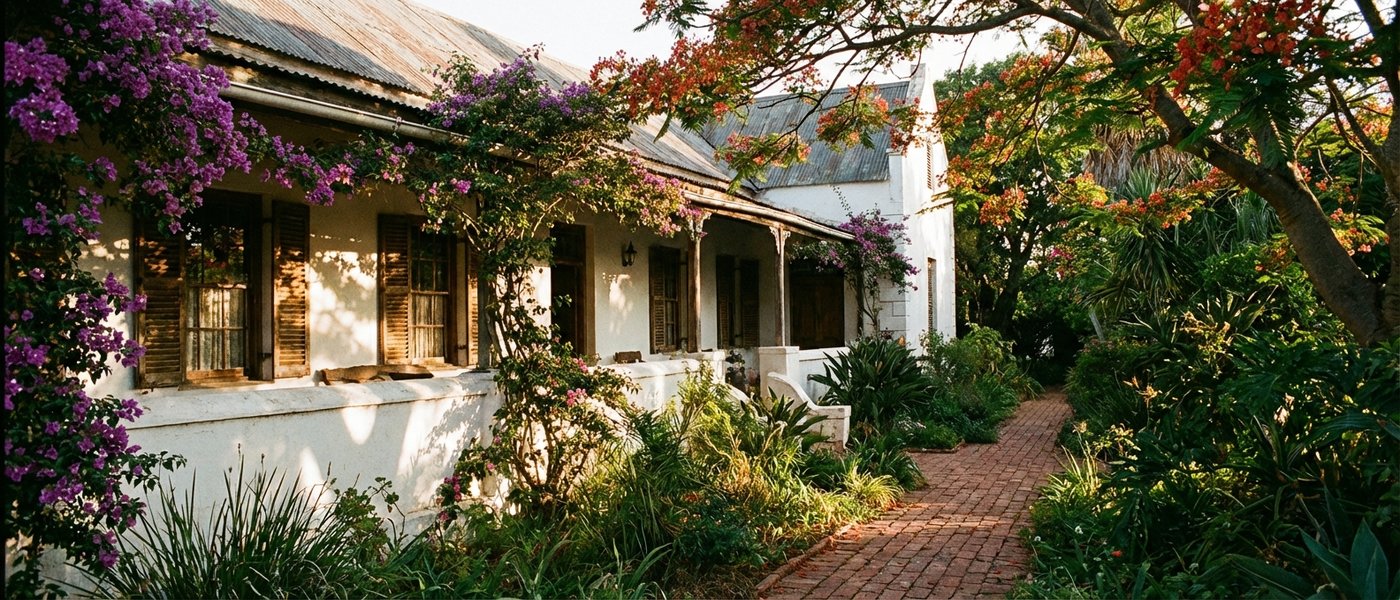
As the tea bushes matured, so did the property. The original farmhouse was extended, room by room, generation by generation. Each addition carried something of its moment — the thick stone foundations of the colonial era, the wider windows of the mid-century, the gardens that grew more elaborate as the family put down deeper roots. The house became a living record of the family's history, each corridor and courtyard a chapter in a story that was still being written.
The Estate Through the Decades
To walk through the Thyolo highlands today is to move through layers of time. There are trees that were planted when the first tea bushes went into the ground, now enormous and cathedral-like in their canopy. There are stone walls that have weathered a century of highland rains. There are views across the working tea fields that have not changed in living memory — the same rolling green geometry, the same distant blue of the Shire Highlands fading into haze.
Through the middle decades of the twentieth century, the estate operated as a working tea farm, as it still does. The rhythms were agricultural: the flush seasons when the new growth was plucked, the factory processing, the quiet of the dry months. The farmhouse was the centre of it all, a place where the boundary between domestic life and the life of the land barely existed. You could stand on the veranda and see the working tea fields in every direction. You could smell the processing from the factory when the wind was right. The estate was not a backdrop to the family's life; it was the family's life.
But working farms, especially in countries navigating the upheavals of independence and economic change, do not stand still. Malawi gained independence in 1964, and the decades that followed brought new realities for the old estates. Some were sold. Some fell into disrepair. The Conforzi family held on, maintaining the land and the house through periods that were not always easy, driven by the stubbornness that seems to run in families who have invested everything in a single piece of ground.
Flavia's Vision
Every old house waits for the person who will see what it could become. For the Conforzi farmhouse, that person was Flavia.
Flavia Conforzi is an artist — a painter whose work draws on African motifs, European traditions, and a deeply personal visual language that is entirely her own. When she took on the restoration and reimagining of the family home, she did not hire a team of interior designers or consult hospitality branding agencies. She picked up her brushes.
The results are extraordinary. Walk into The Tree of Life Room and you are surrounded by a floor-to-ceiling mural inspired by Gustav Klimt — gold and green and sinuous, painted by Flavia's own hand directly onto the walls. It is not a reproduction. It is a conversation between Klimt's Vienna and Flavia's Thyolo, between Art Nouveau and the organic forms of the African bush. It is the kind of room that makes you set down your bag and simply stand there for a moment.
The Heritage Suite tells a different story. Here, a hand-carved African headboard dominates the room, a piece of sculptural furniture that carries the weight and beauty of the continent's artistic traditions. Antique furnishings sit alongside Flavia's original paintings. The ceiling is high, the light is soft, and there is a quality of calm that only comes from rooms that have been genuinely lived in, not merely decorated.
The Pool Cottage offers something else again — privacy, its own rhythm, the sound of water and birdsong. Each space in The Thyolo House has its own character because each one was shaped by hand, by an artist who understands that a room is not a product but an experience.
"I did not want to create a hotel. I wanted to share a home — one that happens to be filled with a century of stories, and art, and the kind of beauty that this land gives you if you pay attention."
Throughout the house, Flavia's collected art mingles with her own work. Sculptures, paintings, textiles, and found objects from across Malawi and beyond create an atmosphere that is part gallery, part family home, part sanctuary. Nothing is behind glass. Nothing feels curated for effect. It feels, instead, like walking into the private world of someone who has spent a lifetime looking closely at beautiful things.
The Garden and the Table
The Conforzi commitment to the land extends beyond tea. The estate maintains a chemical-free garden that supplies the kitchen with herbs, vegetables, salad greens, and fruits — a kitchen garden in the old-fashioned sense, where what you eat for dinner was growing in the soil that morning.
This garden is the foundation of The Thyolo House's Italian fusion restaurant, where Flavia's heritage meets Malawian ingredients in dishes that are impossible to find anywhere else in the country. Homemade pasta with garden herbs. Wood-fired flavours. Fresh produce that has travelled no further than the path from the garden gate to the kitchen door. The Italian tradition of cooking with what the land provides finds its perfect expression here, in a place where the land has been providing for over a century.
There is something deeply satisfying about eating food grown in soil that has been tended by the same family for generations. It is a continuity that most modern dining cannot offer, and it gives every meal at The Thyolo House an authenticity that goes beyond technique or recipe.
What You Find Here Today
The Thyolo Highlands in 2026 is a place where past and present exist in genuine balance. The working tea fields are still worked. The factory still processes leaf. The highland air still carries that particular green-gold light. But now the farmhouse at the centre of it all has opened its doors to travellers, and what they find is unlike anything else in Malawi.
Five rooms, each one individual, each one shaped by Flavia's artistic vision. A restaurant that could hold its own in any city but exists instead on a tea country in the Thyolo highlands. Gardens that are as much a philosophy as a food source. Art on every wall, in every corner, created and collected by someone for whom beauty is not decoration but a way of being in the world.
And underneath all of it, the story. A family who crossed the world and stayed. Who switched crops and weathered decades. Who held onto their land when it would have been easier to let go. Who produced, in Flavia, an artist capable of seeing what the old farmhouse could become and brave enough to make it happen.
The Thyolo House is not a hotel that was built. It is a home that grew — slowly, organically, over more than a hundred years, in one of the most beautiful and least-known corners of Africa. That is what makes it irreplaceable. That is what you feel the moment you arrive.
And that is why, once the light of Thyolo has touched you, a part of you will always want to come back.